DiffSurFlow: Efficient and Robust Differentiable Fluid Optimization via Surrogate Strategy on Flow Map

Yuhao Quan1,*, Hui Wang1,*, Weile Lian1, Zhi Wang1, Xubo Yang1
1Shanghai Jiao Tong University
*Equal contribution.
SIGGRAPH 2026 (Journal Track)

We propose a highly efficient and robust differentiable fluid framework that significantly reduces computational and memory overhead by leveraging a novel physics-informed surrogate gradient method based on flow map structural advantages.

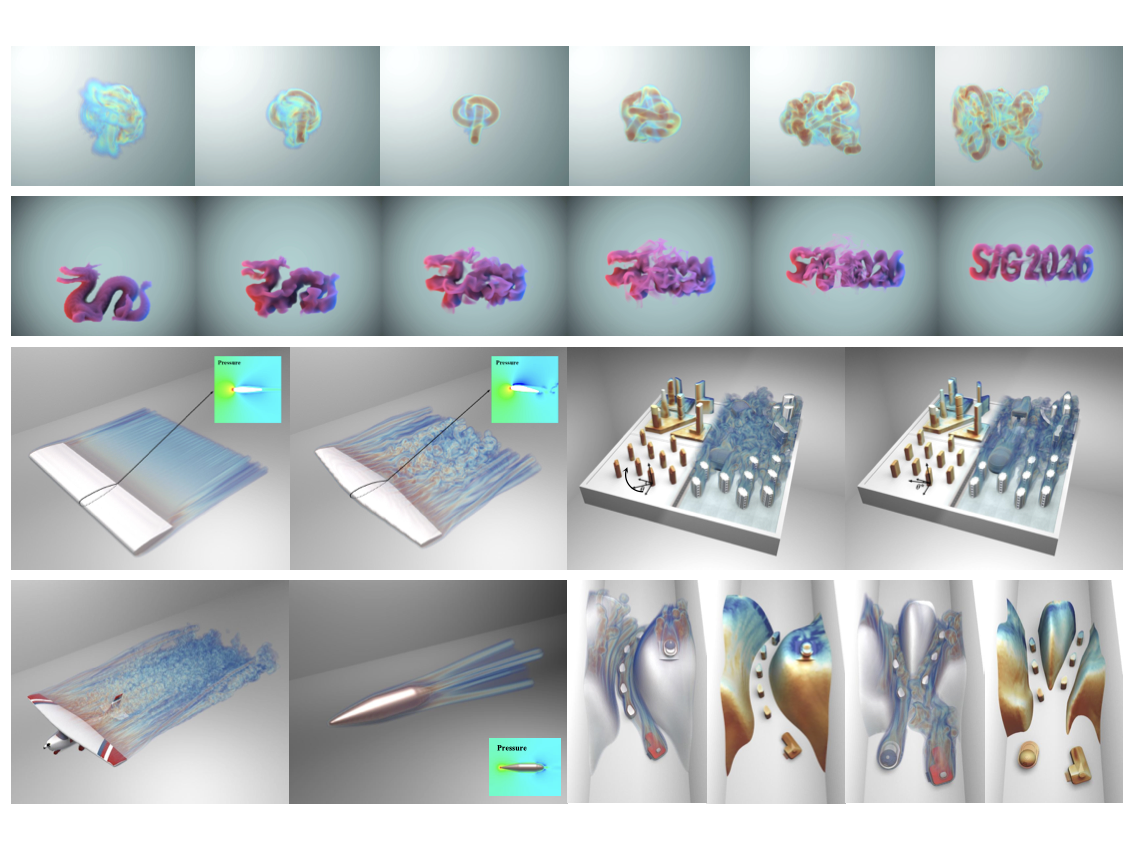
DiffSurFlow teaser showing smoke morphing, airfoil design, city building optimization, and trefoil velocity inference.

Our DiffSurFlow framework effectively addresses a diverse range of fluid optimization tasks characterized by long-term temporal horizons and complex vortex dynamics, as demonstrated by the Dragon-to-SIG2026 smoke morphing via initial velocity field optimization (Top), airfoil shape design for optimizing the lift-to-drag ratio (Middle Left), a large city scenario optimizing building orientations to minimize pressure under a fixed wind field (Middle Right), and a trefoil scenario where the initial velocity is inferred end-to-end to produce a trefoil velocity field (Bottom).

Abstract

This paper presents a highly efficient and robust differentiable fluid framework centered on a novel surrogate gradient method that utilizes the flow map structural advantages. Our key insight reveals a significant misalignment between computational intensity and gradient importance during the backward pass. Specifically, we identify a physical duality within the adjoint process, revealing that the cross-step connections inherent in the flow map act as dominant gradient "highways" that propagate sensitivities over long horizons with high fidelity. Leveraging these insights, we develop a surrogate gradient model that retains these critical connections while pruning redundant adjoint computations in a physics-informed manner. Integrated with tailored acceleration techniques, our framework is successfully applied to diverse, challenging optimization tasks characterized by long time horizons and rich vorticity. Results demonstrate significant speedups and memory reductions while maintaining nearly-identical gradients compared to the full-gradient baseline.

Video

BibTeX

@article{quan2026diffsurflow,
  author    = {Quan, Yuhao and Wang, Hui and Lian, Weile and Wang, Zhi and Yang, Xubo},
  title     = {DiffSurFlow: Efficient and Robust Differentiable Fluid Optimization via Surrogate Strategy on Flow Map},
  journal   = {ACM Transactions on Graphics},
  year      = {2026},
}